Like most building materials, glass comes in several varieties and styles. There are types of glass made for security, aesthetics, privacy, and insulation purposes, and they all differ a bit. Changes in their manufacturing processes can result in increased strength, color changes, and even safer ways of breaking. And each of these types of glass has at least one unique practical use.
This guide on the different types of glass will explain the attributes of glass, as well as the most common glass types, are made along with their common uses.
Three properties of glass
The different varieties of glass all have their attributes and uses. However, there are essentially three properties of glass that are most important in determining their use.
Strength: Whether it’s impact resistance or weight-bearing, the strength of the glass goes a long way toward determining its practical uses. A thick glass that resists impacts is a good choice for storefront glass, display cases, or tall windows. Glass with high weight-bearing capacities can be used for aquariums, suspended walkways, and other uses. Thinner, weaker glass can be used for laminating with other panes to save money.
Transparency: A sheet of glass’s transparency may also determine its best use. Clear glass can be a good choice for windows, doors, or glass cases. Glass obscured with frost, structural irregularities, window film, and tinted hues may be helpful for privacy situations like shower glass and neighbor-facing windows. Tinted glass can also prevent the free passage of the sun’s UV rays.
U Value: U Value explains how well a sheet of glass will prevent heated or cooled air from passing through. While the specific uses of low U Value glass are limited, high U Value is most helpful for use in windows and doors.
And now we will discuss the main types of glasses used in construction and their various properties:
Sheet or Flat Glass
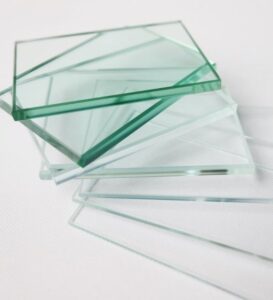
sheet glass, or plate glass is a type of glass that is initially produced in plane form. It is commonly used for windows, glass doors, transparent walls, and windshields. For modern architectural and automotive applications, the flat glass is sometimes bent after the production of the plane sheet. It is commonly used for windows, glass doors, transparent walls, and windscreens. For modern architectural and automotive applications, the flat glass is sometimes bent after the production of the plane sheet.
Laminated Glass
Laminated glass is constructed of two plies of glass that are bonded together with interlayers to form a permanent bond. The interlayers work to support and hold the glass to create a strong, uniform layer even when broken. Laminated glass comes in varying thicknesses and can be created using different glass combinations or coatings to provide different qualities, such as low emissions or increased insulation. Laminated glass is used when there is a possibility of human impact or where the glass could fall if shattered and for architectural applications. Skylight glazing and automobile windshields typically use laminated glass. In geographical areas requiring hurricane-resistant construction, laminated glass is often used in exterior storefronts, curtain walls, and windows.
Shatterproof Glass
Shatterproof glass is laminated glass; two or more sheets of glass bound together with an invisible interlayer of polyvinyl or resin, though other compounds are sometimes used. The interlayers of shatterproof glass help to reduce sound transmission; your home will be significantly quieter. UV rays are also reduced by this type of glass, keeping the sun from fading fabrics and furniture.
Energy-efficient Glass
Energy-efficient Glass is manufactured by glazing float glass with a special thin coating on one side. Energy-efficient glazing incorporates low-emissivity coated glass to prevent heat from escaping through the windows. This makes the windows highly thermally insulating hence improving the energy efficiency of your building.
Wired Glass
Wired glass is being used for decades now and it prevents the glass from shattering in case of emergencies. The glass is reinforced with wire mesh during manufacture, which makes it durable, and fire-resistant when compared to float glass. It is also known as Georgian wired glass and wire mesh works as a reinforcement. In case due to some higher impact activity the glass breaks, it is held by the wire in position. This lessens the chances of anyone around getting hurt. The wire mesh glass is available in diamond grids and square grids.
Stained Glass
Stained glass refers to colored glass as a material and works created from it. Throughout its thousand-year history, the term has been applied almost exclusively to the windows of churches and other significant religious buildings. Although traditionally made in flat panels and used as windows, the creations of modern stained-glass artists also include three-dimensional structures and sculpture.
Toughened Glass
Toughened glass is physically as well as thermally solid, and research shows that it can withstand surface compression of at least 10,000 lbs per square inch, which is why toughened glass is considered to be safety glass. They are also known to be four to five times stronger than annealed glass and three times stronger than heat-strengthened glass. As these glasses are robust, they reduce the risk of damage if they come in contact with a calamity or disaster. Toughened glass is manufactured when regular glass is exposed to extreme heat and then cooled rapidly. Due to this excessive heating and cooling process, the chemical composition of the glass goes through an alteration making it more resilient.
Chromatic Glass
Chromatic glass can control the transparent efficiency of glass and protects the interior from daylight. The chromatic glass may be photochromic which has light-sensitive lamination, thermos-chromatic which has heat-sensitive lamination, and electrochromic.
Self-Cleaning Glass
Self-cleaning glass is a specific type of glass with a surface that keeps itself free of dirt and grime. The field of self-cleaning coatings on glass is divided into two categories: hydrophobic and hydrophilic. These two types of coating both clean themselves through the action of water, the former by rolling droplets and the latter by sheeting water that carries away dirt. Hydrophilic coatings based on titania (titanium dioxide), however, have an additional property: they can chemically break down absorbed dirt in sunlight.
Float Glass
Float glass is a sheet of glass made by floating molten glass on a bed of molten metal, typically tin, although lead and other various low-melting-point alloys were used in the past. This method gives the sheet uniform thickness and very flat surfaces. Modern windows are made from float glass. Most float glass is soda-lime glass, although relatively minor quantities of specialty borosilicate and flat panel display glass are also produced using the float glass process. Float glass is essentially a super smooth, distortion-free glass that is used for designing other glass items such as laminated glass, heat-toughened glass, and so on. With a natural greenish hue and translucent nature, it is capable of transmitting incident light.
Given above are different types of glass that could be used for building architecture. Glass is used as a transparent glazing element in the building envelope. This includes windows in external walls and internal partitions.